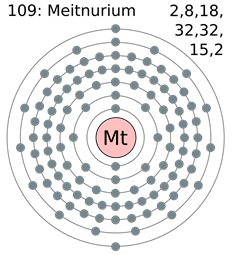
Meitnerium is a synthetic chemical element with symbol Mt and atomic number 109. It is an extremely radioactive synthetic element (an element not found in nature, but can be created in a laboratory). The most stable known isotope, meitnerium-278, has a half-life of 7.6 seconds, although the unconfirmed meitnerium-282 may have a longer half-life of 67 seconds. The GSI Helmholtz Centre for Heavy Ion Research near Darmstadt, Germany, first created this element in 1982. It is named after Lise Meitner.
In the periodic table, meitnerium is a d-block transactinide element. It is a member of the 7th period and is placed in the group 9 elements, although no chemical experiments have yet been carried out to confirm that it behaves as the heavier homologue to iridium in group 9 as the seventh member of the 6d series of transition metals. Meitnerium is calculated to have similar properties to its lighter homologues, cobalt, rhodium, and iridium.
Meitnerium was first synthesized on August 29, 1982 by a German research team led by Peter Armbruster and Gottfried Münzenberg at the Institute for Heavy Ion Research (Gesellschaft für Schwerionenforschung) in Darmstadt.The team bombarded a target of bismuth-209 with accelerated nuclei of iron-58 and detected a single atom of the isotope meitnerium-266.
This work was confirmed three years later at the Joint Institute for Nuclear Research at Dubna (then in the Soviet Union).
In the periodic table, meitnerium is a d-block transactinide element. It is a member of the 7th period and is placed in the group 9 elements, although no chemical experiments have yet been carried out to confirm that it behaves as the heavier homologue to iridium in group 9 as the seventh member of the 6d series of transition metals. Meitnerium is calculated to have similar properties to its lighter homologues, cobalt, rhodium, and iridium.
Meitnerium was first synthesized on August 29, 1982 by a German research team led by Peter Armbruster and Gottfried Münzenberg at the Institute for Heavy Ion Research (Gesellschaft für Schwerionenforschung) in Darmstadt.The team bombarded a target of bismuth-209 with accelerated nuclei of iron-58 and detected a single atom of the isotope meitnerium-266.
This work was confirmed three years later at the Joint Institute for Nuclear Research at Dubna (then in the Soviet Union).